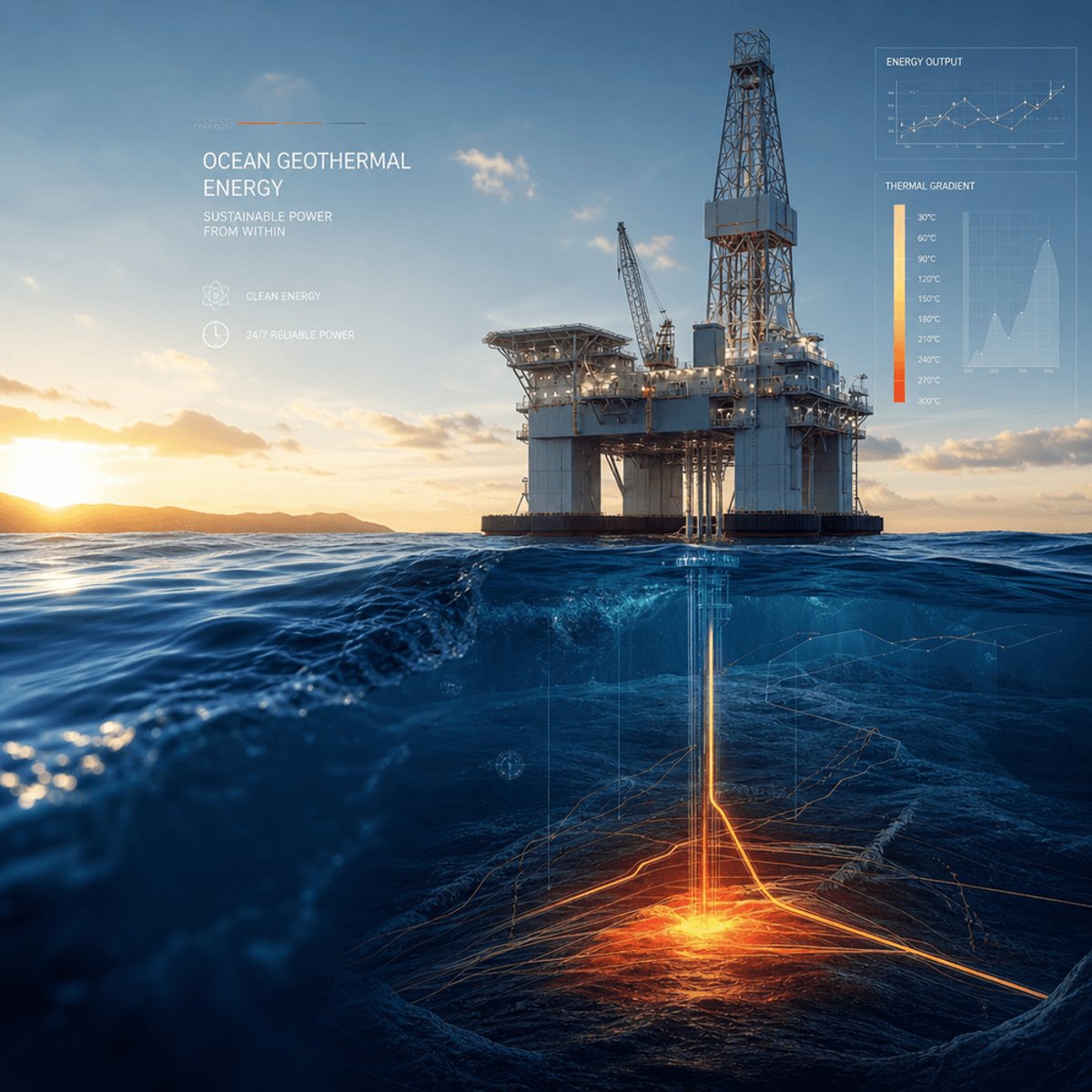
A SpaceX veteran just closed one of the year's biggest climate tech deals to chase energy hidden beneath the ocean floor. Endurance Energy announced a $54 million funding round today to develop offshore geothermal systems, betting that subsea heat reservoirs could become a major clean energy source. Founder Andrew Redd, who previously worked on SpaceX's Starship program, thinks conventional geothermal has barely scratched the surface of what's possible when you go offshore.
Endurance Energy just pulled in $54 million to prove that the next big breakthrough in clean energy might be sitting right under the ocean. The startup, led by former SpaceX engineer Andrew Redd, announced the funding round today with plans to develop offshore geothermal systems that could tap into heat reservoirs land-based plants can't touch.
Redd's not the first person to think about geothermal energy, but he might be one of the first to seriously attack the ocean angle with serious capital behind him. Traditional geothermal plants need to be built near volcanic hotspots or specific geological formations, limiting where they can operate. That geographic constraint has kept geothermal at around 0.4% of U.S. electricity generation despite decades of development. Endurance Energy wants to change that math by drilling offshore where subsea geology opens up vast new territory.
The timing makes sense when you look at what's happening in energy markets right now. Tech giants are scrambling to lock down clean baseload power for their expanding AI infrastructure. Wind and solar can't run 24/7, batteries remain expensive for long-duration storage, and nuclear faces regulatory hurdles. Geothermal delivers constant output without emissions, but it's been stuck in niche applications. If Redd can prove the ocean model works, he's potentially unlocking a massive new category of sites.
Redd spent years at SpaceX working on Starship before jumping into the energy sector, bringing aerospace engineering discipline to what's essentially a deep-sea drilling challenge. According to TechCrunch, he believes the ocean floor offers better access to geothermal gradients than most land locations, with less surface disruption and fewer permitting battles. The $54 million round will fund initial drilling tests and technology development to prove the concept can scale.
The offshore approach does introduce new engineering problems. Drilling in ocean environments costs more than land-based operations, subsea equipment needs to withstand corrosive saltwater, and connecting underwater geothermal plants to coastal power grids requires specialized infrastructure. But Redd's apparently convinced investors that aerospace-grade engineering and modern drilling tech have advanced enough to make it economically viable. The funding signals that institutional investors see potential in next-generation geothermal beyond the conventional playbook.
Endurance Energy joins a growing wave of startups trying to reinvent geothermal for the AI era. Companies like Fervo Energy have raised hundreds of millions to drill enhanced geothermal systems in previously unviable locations, while others experiment with closed-loop designs that don't require specific rock formations. The sector's seeing renewed attention as data center operators look for clean firm power that can match their growth projections. Google and Microsoft have both signed geothermal power purchase agreements in recent years, validating the technology's potential role in corporate climate commitments.
What sets ocean geothermal apart is the sheer scale of available resource. The seafloor covers 70% of the planet and contains enormous thermal energy, especially near tectonic plate boundaries and volcanic zones offshore. If Endurance can figure out the cost equation, they're not just competing with other geothermal players but potentially offering an alternative to offshore wind farms and floating solar arrays. The baseload advantage gives geothermal a leg up on intermittent renewables if the economics work.
Redd hasn't disclosed the full investor lineup yet, but climate tech funds have been aggressively backing infrastructure plays that can deliver dispatchable clean power. The $54 million raise is substantial for an early-stage energy hardware company, suggesting heavyweight backers who understand the capital intensity of the sector. Endurance will need to prove its drilling technology and show viable economics before it can attract project finance for full-scale deployments, but this round gives them runway to hit those milestones.
The company faces a classic cleantech scale-up challenge - proving a novel technology while building an entirely new supply chain and regulatory pathway. Offshore energy projects involve complex permitting across federal and state jurisdictions, environmental impact reviews, and coordination with existing maritime industries. But if anyone's equipped to handle that kind of systems-level problem, it's probably someone who worked on landing rockets on drone ships. Redd's SpaceX background suggests he's comfortable with ambitious timelines and iterative testing.
For the broader energy transition, ocean geothermal represents the kind of moonshot bet that could reshape infrastructure planning. Coastal regions account for a huge share of electricity demand, and offshore geothermal could deliver power directly to population centers without long-distance transmission lines. Whether Endurance Energy can actually pull it off remains to be seen, but $54 million says investors think it's worth finding out.
Endurance Energy's $54 million bet on ocean geothermal comes at a moment when clean baseload power has become the energy sector's most valuable commodity. If Redd and his team can crack the offshore drilling economics and navigate the regulatory maze, they might just unlock a massive new energy resource that's been sitting under the waves this whole time. For now, investors are betting that SpaceX-level engineering ambition can translate to the seafloor, and that ocean geothermal will become more than just a clever idea. The next 18 months will show whether that bet pays off or if offshore geothermal remains too expensive to compete with the alternatives flooding the market.