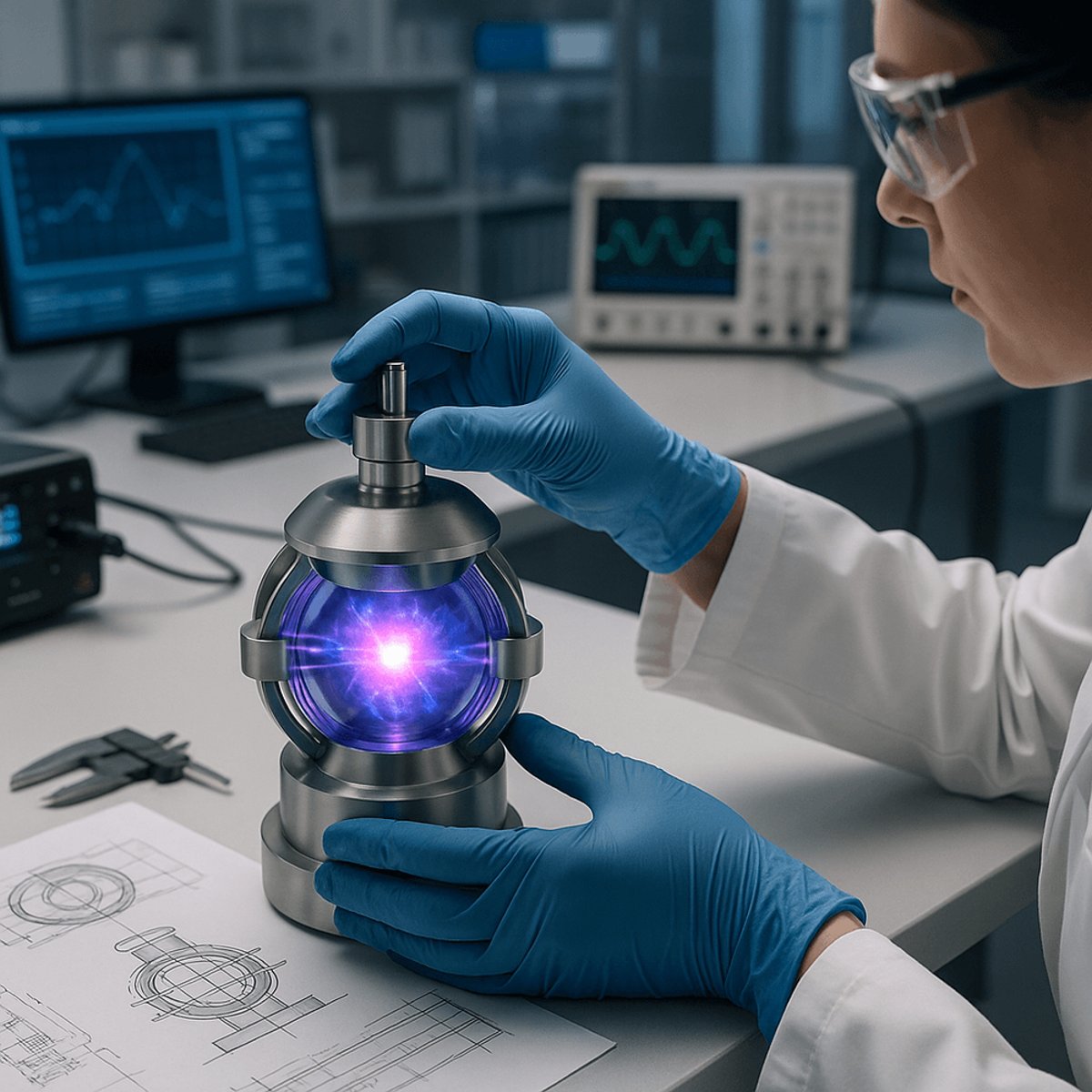
While fusion giants burn through billions building warehouse-sized reactors, Avalanche Energy just raised $29 million to prove desktop-sized can win the race to clean power. The Seattle-based startup's reactor currently fits on a table at nine centimeters across, but CEO Robin Langtry says going small lets his team iterate twice weekly - a pace that's impossible when your tokamak needs a building permit. The round, led by RA Capital Management, brings Avalanche's total raised to $80 million, a fraction of what competitors like Commonwealth Fusion Systems and Helion have pulled in.
Avalanche Energy just flipped the script on fusion power. While the industry obsesses over building bigger magnets and more powerful lasers, the Seattle startup closed a $29 million round to prove that table-top reactors can beat the behemoths to commercial fusion.
The Series B was led by RA Capital Management, with participation from 8090 Ventures, Congruent Ventures, Founders Fund, Lowercarbon Capital, Overlay Capital, and Toyota Ventures. It brings Avalanche's total raised to $80 million since founding - a relatively modest war chest in an industry where competitors have raised hundreds of millions to several billion dollars, according to TechCrunch's fusion funding tracker.
But Avalanche co-founder and CEO Robin Langtry isn't trying to out-spend the competition. He's trying to out-iterate them. "We're using the small size to learn quickly and iterate quickly," Langtry told TechCrunch.
The company's current reactor measures just nine centimeters in diameter. That compact footprint means Avalanche can test design changes "sometimes twice a week," Langtry said - a cadence that would be impossible with the massive tokamaks and laser arrays that dominate fusion research. When your reactor fits on a lab bench instead of filling a warehouse, iteration cycles collapse from years to days.
Avalanche's approach diverges sharply from mainstream fusion methods. Instead of using enormous magnets to contain plasma in a doughnut-shaped tokamak like Commonwealth Fusion Systems, or compressing fuel pellets with powerful lasers, Avalanche uses extremely high-voltage electric current to draw plasma particles into an orbit around an electrode. Some magnets help maintain order, but they're far less powerful than a tokamak's. As the orbit tightens and plasma speeds up, particles collide and fuse - releasing energy.
Langtry's approach borrows from his time at Blue Origin, the Jeff Bezos-backed space company where he worked alongside Avalanche co-founder Brian Riordan. "We've figured out that using this sort of SpaceX 'new space' approach is that you can iterate really quickly, you can learn really quickly, and you can solve some of these challenges," he said.
That rapid-iteration philosophy extends beyond the reactor itself. Avalanche operates FusionWERX, a commercial testing facility in Seattle that the company rents out to competitors. By 2027, the site will be licensed to handle tritium, a hydrogen isotope that's critical fuel for fusion reactions and central to most startups' plans for grid-scale power generation.
The next milestone is scaling up without slowing down. Avalanche's upcoming reactor will grow to 25 centimeters in diameter and target about 1 megawatt of output. More importantly, Langtry said, it should achieve significantly longer plasma confinement times - the key to reaching Q>1, the industry's holy grail where fusion devices produce more energy than they consume.
Langtry wouldn't commit to a specific date for hitting breakeven, but he believes Avalanche is tracking with better-funded rivals like Commonwealth Fusion Systems and Sam Altman-backed Helion. "I think there's going to be a lot of really exciting things happening in fusion in 2027 to 2029," he said.
The funding environment suggests investors are betting on multiple horses in the fusion race. While Avalanche's $80 million total seems modest, it reflects a different capital strategy - one that prioritizes speed and flexibility over scale. Fusion remains notoriously difficult: the physics are punishing, materials science is bleeding-edge, and power requirements can be massive. Parts demand precision machining, and most approaches require such large scale that rapid experimentation becomes prohibitively expensive.
But the climate tech investment community is warming to alternatives. Lowercarbon Capital and Congruent Ventures have both made aggressive bets on novel energy technologies, while Founders Fund has historically backed contrarian technical approaches. Toyota Ventures' participation signals automotive industry interest in compact, distributed fusion as a potential future power source.
Avalanche hit a key technical milestone last summer when it demonstrated sustained plasma confinement in its desktop reactor, according to previous TechCrunch reporting. That progress convinced investors the company's unconventional approach could work at commercial scale.
The real test comes in the next 18 to 36 months, as Avalanche scales from 9cm to 25cm and attempts to prove its compact reactor can achieve the plasma temperatures, densities, and confinement times needed for net energy gain. If it succeeds, the company will have validated a dramatically cheaper development path for fusion power - one that could democratize access to what's long been a capital-intensive moonshot.
Avalanche's $29 million bet on miniaturization represents a fundamental challenge to fusion orthodoxy. While billion-dollar competitors race to build the biggest magnets and most powerful lasers, Langtry's team is proving that smaller, faster, and cheaper might be the actual path to commercial fusion. The next two years will reveal whether desktop-sized reactors can deliver grid-scale power - and if they do, the entire industry may need to rethink its obsession with going big. For climate tech investors, Avalanche offers a compelling alternative thesis: sometimes the fastest way to solve an impossibly hard problem is to make it small enough to fail fast and iterate faster.