Samsung just turned blood donation into a VR meditation session. The tech giant partnered with healthcare company Abbott to launch Korea's first XR-powered blood drive on June 2, using Galaxy XR headsets to calm donor nerves with gaze-controlled Zen gardens and Chicago Symphony Orchestra scores. The initiative kicked off at Samsung Digital City in Suwon with Korean Red Cross support and is now rolling out to major XR and healthcare events in the US and Malaysia as the companies bet that immersive tech can ease one of healthcare's most anxiety-inducing experiences.
Samsung is putting a new spin on blood donation, and it involves strapping on a headset before rolling up your sleeve. The company's Galaxy XR device is now being deployed at blood drives in partnership with Abbott, transforming what's typically a clinical, sometimes nerve-wracking experience into an immersive meditation session.
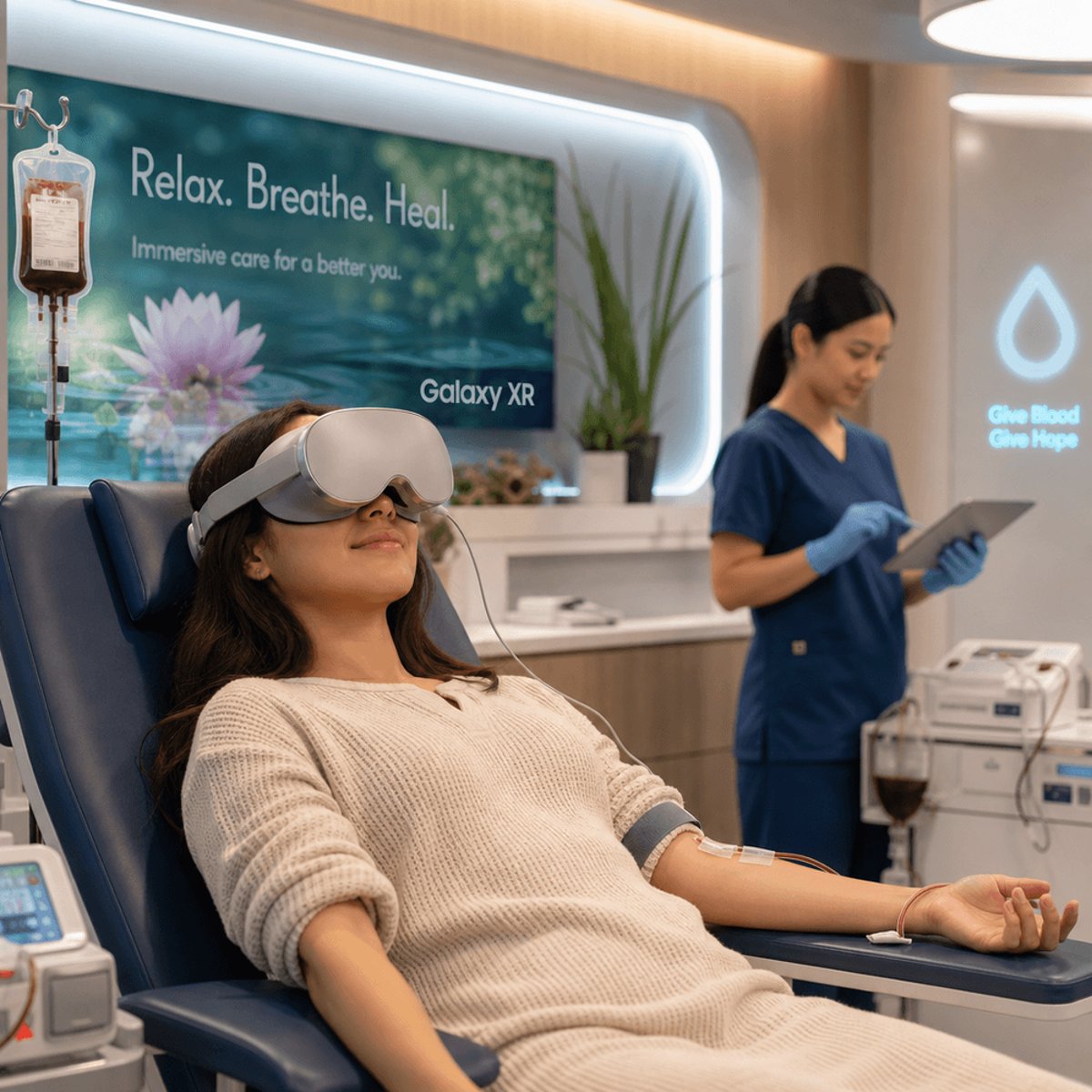
On June 2, Samsung employees at the company's Digital City campus in Suwon, South Korea, became the first donors to experience the XR-powered blood donation setup. Working with the Korean Red Cross in recognition of World Blood Donor Day, Samsung and Abbott turned a standard workplace blood drive into a proof-of-concept for how extended reality might make healthcare procedures less stressful. Employees donned Galaxy XR headsets and spent their donation time in a virtual Zen garden instead of staring at ceiling tiles.
The experience itself is deliberately simple. Once the headset is on, donors enter a calming environment inspired by Japanese gardens. Using only their gaze - no hand controllers, no gestures - they plant virtual flower seeds just by looking at spots on the ground. Over three to five minutes, flowers and trees bloom around them while music created with the Chicago Symphony Orchestra plays in the background. It's a bet that distraction plus meditation beats anxiety.
"As the boundary between the physical and digital worlds continues to blur, blood donation no longer has to be a stressful experience," James Park, EVP of Samsung's Global Mobile B2B Team, told Samsung's newsroom. "Through this initiative, we hope to demonstrate how Galaxy XR can extend beyond entertainment and productivity to create lasting social value."
For Abbott, which has been running blood donation campaigns with Red Cross organizations in nearly 30 countries since 2016, the Samsung partnership represents a hardware upgrade to existing VR donation programs. Miguel Carrazza from Abbott's Transfusion Medicine division pointed to Android XR - the platform powering Galaxy XR - as particularly suited for healthcare settings because medical staff can still monitor donors while they're immersed in the experience. The headset's design keeps donors naturally engaged without isolating them from their surroundings.
"Samsung Galaxy XR, powered by Android XR, represents a significant advancement for our mixed reality blood donation program," Carrazza said in the announcement. "It is well-suited for healthcare settings, allowing medical staff to monitor donors more easily while helping them stay naturally engaged."
The Korea campaign drew participation from Samsung employees across divisions. Geunwoo Park from the Networks Business unit, who donates annually, said the XR element made the typically monotonous wait more enjoyable. "I try to donate blood at least once a year, but it can feel a little boring since you have to sit still," Park explained. "Using Galaxy XR made it more enjoyable because there was something engaging to watch."
Gangsu Kim, a 20-time donor from Samsung's Visual Display Business, highlighted the gaze-based interaction as particularly compelling. "It was a unique experience to try Galaxy XR while donating blood," Kim noted. "I found the interactive content especially fascinating because it responded to where I was looking."
Now Samsung and Abbott are taking the program global. From June 15-18, the companies will host a four-day blood drive at Augmented World Expo in Long Beach, California, bringing the Galaxy XR donation experience directly to thousands of XR industry professionals and enthusiasts. It's strategic timing - AWE attracts developers, investors, and enterprise buyers who could shape how XR gets deployed in healthcare settings.
Later this month, the initiative heads to the International Society of Blood Transfusion Congress in Kuala Lumpur, Malaysia, where more than 100 blood bank decision-makers from around the world will get hands-on exposure to the technology. That's where the real scaling could happen - if blood bank administrators see value in XR as a donor recruitment and retention tool, the model could spread beyond Samsung-Abbott activations.
The move positions Galaxy XR as more than a consumer entertainment device or enterprise productivity tool. Samsung is clearly looking for use cases that demonstrate social impact, especially as the company competes with Meta and Apple in the mixed reality space. Blood donation is a clever wedge - it's universally understood, frequently needed, and often anxiety-inducing for first-time or nervous donors.
For Abbott, the partnership offers a hardware refresh for a program that's already touched dozens of countries. The company's existing VR initiatives have shown that immersive tech can improve donor comfort, but Galaxy XR's gaze-based controls and Android XR platform could make the experience easier to deploy and manage across different healthcare environments. No training on controllers, no complex setup - just put on the headset and look around.
The question is whether blood banks and Red Cross chapters will adopt the tech at scale. Hardware costs, content licensing, sanitation between donors, and staff training all factor into deployment decisions. Samsung and Abbott are betting that showcasing the experience at major industry events will build enough momentum to turn pilot programs into standard practice.
Samsung's Galaxy XR blood donation push with Abbott is a sharp play for real-world XR credibility beyond gaming and enterprise collaboration. If the AWE and ISBT showcases convince blood bank administrators that immersive tech genuinely improves donor experience and retention, the model could scale globally - giving Samsung a healthcare foothold while Abbott modernizes a decade-old VR program. The bigger test comes when the headsets leave trade show floors and land in everyday blood drives, where logistics, cost, and actual donor behavior will determine whether this is a novelty or a new standard.