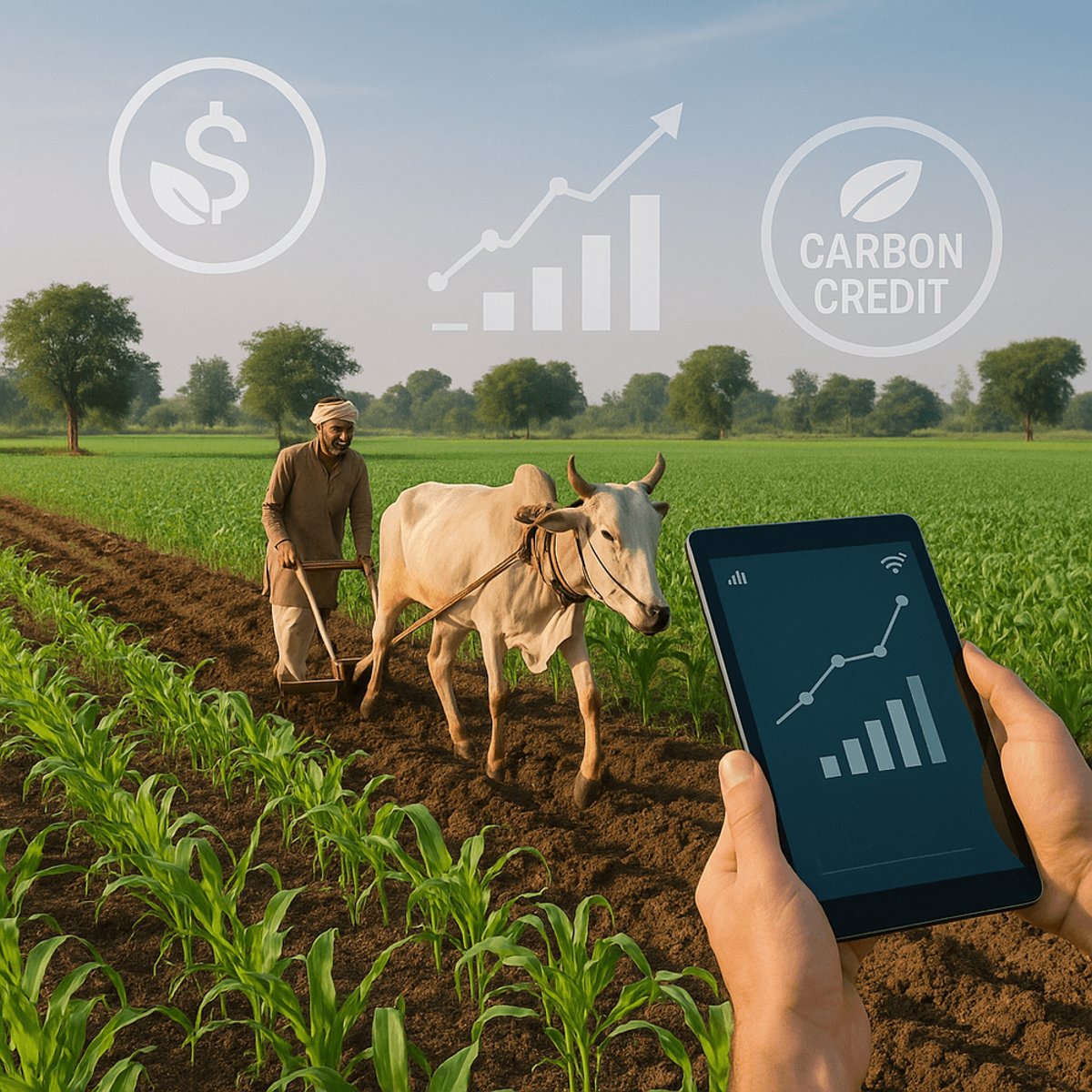
Mirova, the climate investment arm backed by luxury giant Kering, just dropped $30.5 million into Indian agtech startup Varaha in a deal that could reshape how carbon credits work in agriculture. The investment - structured as a revenue-share on carbon credits rather than traditional equity - will help Varaha scale regenerative farming practices across 675,000 hectares in northern India, supporting over 337,000 smallholder farmers.
Mirova, the Paris-based climate investment firm backed by Kering and other corporate heavyweights, just made its first carbon investment in India - and it's not your typical funding round. The $30.5 million deal with agtech startup Varaha skips equity entirely, instead giving Mirova a share of carbon credits generated over time. It's a bet that regenerative farming can deliver both climate impact and financial returns at massive scale.
The timing couldn't be more critical. India's agricultural sector is facing a perfect storm of declining soil fertility, erratic rainfall, and widespread stubble burning that chokes Delhi's air quality every winter. Varaha's solution tackles all three problems through its Kheti project, which works with farmers in Haryana and Punjab to adopt low-emission practices that generate verified carbon credits.
"Instead of burning the residue, you use agricultural machinery to cut it on the farm and mix it back into the soil," Varaha co-founder and CEO Madhur Jain told TechCrunch. The startup focuses on direct seeding of rice and incorporating crop residue - a crucial alternative to the widespread practice of burning stubble after harvest that contributes to northern India's air pollution crisis.
Founded in 2022, Varaha has already built impressive momentum. The startup operates through a network of 48 local partners, with software that monitors projects in real-time and verifies both climate and social outcomes. Current operations cover over 200,000 hectares, but Mirova's investment will help scale that to 675,000 hectares reaching 337,000 farmers.
The revenue structure reflects a broader shift in climate investing. Rather than traditional venture capital, Mirova - an affiliate of Natixis Investment Managers - channels corporate capital into verified emissions-reduction projects. The firm's backers include Gucci parent Kering, Orange, L'Occitane Group, Capgemini, and others seeking credible carbon offsets for their supply chains.
Varaha's approach goes beyond carbon accounting. The startup promotes reduced tillage, cutting back from multiple ploughing rounds to just one or two, which helps conserve soil carbon and improve long-term storage capacity. But scaling these practices requires serious hardware investment. "If you have to do direct seeding of rice rather than transplanting, which requires a lot of water, you need thousands of direct seeders," Jain explained. "Because this isn't yet a conventional practice, the number of seeders available in the market is much lower than what's required."
The startup's credibility got a major boost earlier this year when Google signed what Varaha called the world's largest biochar carbon removal deal. The tech giant will purchase 100,000 tons of carbon dioxide removal credits by 2030, validating the startup's approach at enterprise scale.
Carbon credit verification remains contentious territory. Varaha uses Verra's VM0042 methodology, despite the non-profit facing criticism over some forest projects that may have overstated carbon savings. Jain defends the choice: "On the soil organic carbon side, none of Verra's credits have been questioned so far by anyone." The startup also works with other standards including Puro and Isometric to diversify verification sources.
The investment comes as regenerative farming gains traction globally as a practical climate solution. Unlike carbon capture technology that's still scaling, regenerative practices offer immediate benefits - improved soil health, reduced water use, higher crop yields, and lower farming costs. For India's smallholder farmers facing climate uncertainty, it's as much about survival as sustainability.
Varaha has raised $12.7 million in venture funding to date, including an $8.7 million Series A last year from investors including RTP Global, Omnivore, and Japan's Norinchukin Bank. The Mirova deal represents a new model - patient capital tied to measurable climate outcomes rather than traditional growth metrics.
Mirova's investment in Varaha signals a maturation in climate finance - moving beyond venture capital toward outcome-based structures that tie returns directly to environmental impact. As corporate buyers demand credible carbon offsets and farmers face increasing climate pressure, this model could become the template for scaling agricultural climate solutions. The real test will be whether Varaha can maintain quality verification while expanding to hundreds of thousands of farmers across India's complex agricultural landscape.